
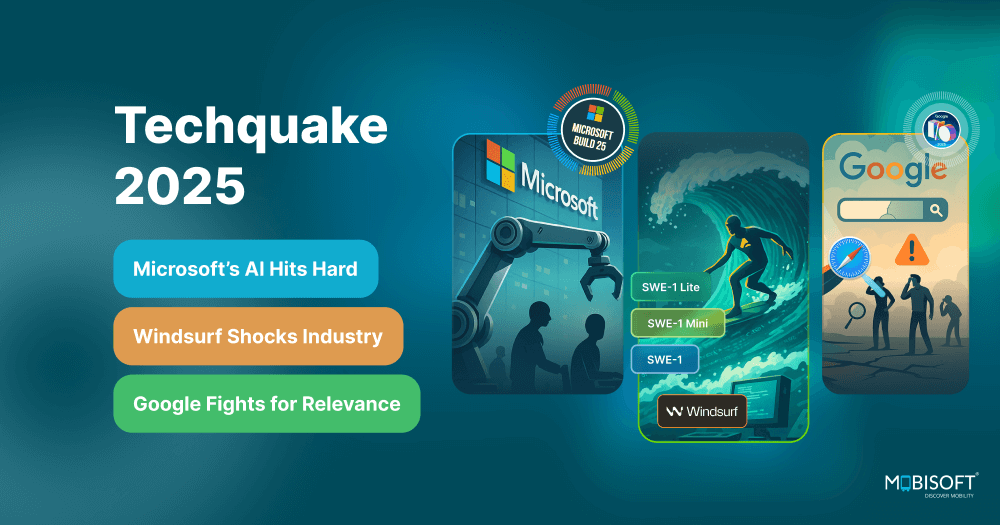
Techquake: The Ground Shifts Again
Introduction
Remember that scene in your favorite action movie where everything’s calm, maybe a little too calm, and then BAM! The ground starts shaking, things are collapsing, and suddenly everyone’s scrambling? Well, buckle up, because that’s pretty much where we are in the tech world right now. We’re calling it a “Techquake,” and it’s not some futuristic sci-fi fantasy; it’s the very real, very present, and very impactful shift happening across industries due to the relentless advance of artificial intelligence (AI).
Forget the slow, incremental changes we’re used to. This isn’t about a slightly faster processor or a marginally better app. This is a fundamental restructuring of how we work, how we interact, and how we even think. Think of the internet’s arrival, the mobile revolution, and the cloud transformation all rolled into one, but on hyperdrive. Intrigued? You should be.
So, what exactly is causing this Techquake, and more importantly, what does it mean for you, your career, and your business? Let’s dive in and navigate this shifting landscape together.
The Fault Lines: AI’s Short-Term Tremors
In the immediate aftermath of any earthquake, the tremors are the most jarring. With AI, these tremors are already being felt across various sectors.
- Job Displacement (and Transformation): Let’s address the elephant in the room. AI-powered automation is undoubtedly changing the job market. Repetitive, rule-based tasks are prime candidates for automation, leading to potential job losses in areas like data entry, customer service, and even some aspects of programming. However, this isn’t just about job losses. It’s also about job transformation. Think of it less as robots stealing jobs and more as AI becoming a super-powered assistant, freeing up human workers to focus on more creative, strategic, and emotionally intelligent tasks.
- The Skill Gap Widens: As AI takes over mundane tasks, the demand for skills like AI development, data science, AI ethics, and AI-augmented roles (imagine a doctor using AI for diagnostics) will explode. The problem? We’re not producing skilled professionals fast enough to meet that demand. This creates a significant skill gap, potentially leaving many individuals behind.
- Ethical Quandaries: AI is only as good as the data it’s trained on. Biased data leads to biased AI, perpetuating and amplifying existing societal inequalities. Consider facial recognition software that struggles to accurately identify people of color, or AI-powered hiring tools that inadvertently discriminate against certain demographic groups. These ethical challenges require careful consideration and proactive solutions.
- The Proliferation of Misinformation: AI can generate incredibly realistic fake content, making it harder than ever to distinguish between what’s real and what’s fabricated. This “deepfake” technology has the potential to wreak havoc on public trust, influence elections, and damage reputations.
The Aftershocks: Long-Term Seismic Shifts
The long-term impacts of the Techquake are even more profound, reshaping the very foundations of our society.
- The Rise of the Augmented Workforce: In the future, we’ll see a seamless integration of humans and AI, working side-by-side in almost every industry. Doctors will use AI to diagnose diseases with unprecedented accuracy, marketers will use AI to personalize customer experiences, and engineers will use AI to design more efficient and sustainable infrastructure. This augmented workforce will be more productive, more innovative, and more adaptable than anything we’ve seen before.
- The Democratization of Expertise: AI can democratize access to expertise and knowledge, making it available to everyone, regardless of their background or location. Imagine AI-powered tutoring systems that provide personalized learning experiences, or AI-driven diagnostic tools that can be used in remote areas with limited access to healthcare.
- A New Era of Creativity and Innovation: By automating routine tasks, AI can free up human creativity and innovation, allowing us to focus on solving complex problems and pursuing ambitious goals. We might see a surge in new artistic expressions, scientific discoveries, and technological breakthroughs as AI becomes a powerful tool for human exploration and invention.
- The Redefinition of Work and Value: As AI takes over more tasks, we’ll need to rethink our understanding of work and value. What does it mean to be productive in a world where machines can do much of the work for us? How do we ensure that everyone benefits from the wealth created by AI, and not just a select few? These are fundamental questions that we’ll need to address in the coming years.
Building Earthquake-Resistant Structures: Practical Solutions
So, how do we navigate this Techquake and ensure that we not only survive but thrive in the new AI-powered world? Here are some practical solutions:
- Embrace Lifelong Learning: The single most important thing you can do is commit to continuous learning. Focus on developing skills that are difficult to automate, such as critical thinking, problem-solving, creativity, emotional intelligence, and communication. Take online courses, attend workshops, read books, and stay up-to-date on the latest AI trends and technologies.
- Example: Platforms like Coursera, edX, and Udacity offer a wide range of AI-related courses, from introductory overviews to advanced machine learning specializations.
- Focus on Human-Centered Skills: AI excels at data processing and pattern recognition, but it still lacks the uniquely human capabilities of empathy, creativity, and critical thinking. Cultivate these skills, as they will become increasingly valuable in the age of AI.
- Example: Consider taking a course on design thinking, which emphasizes human-centered problem-solving.
- Upskill and Reskill: Identify the skills that are in demand in your industry and invest in training to acquire those skills. This might involve learning a new programming language, mastering data analytics, or becoming proficient in AI ethics.
- Example: Many companies are offering internal training programs to help employees upskill and reskill for the AI-powered workplace.
- Become an AI Translator: Bridge the gap between technical AI experts and business stakeholders. Develop the ability to understand AI concepts and translate them into practical business applications.
- Example: Learn how to use AI tools to analyze customer data and develop personalized marketing campaigns.
- Promote Ethical AI Development: Advocate for the responsible development and deployment of AI. Support initiatives that promote fairness, transparency, and accountability in AI systems.
- Example: Join a professional organization that focuses on AI ethics, such as the IEEE’s Ethically Aligned Design initiative.
- Prepare for the Future of Work: Be open to new ways of working, such as remote work, freelance work, and gig work. Develop your adaptability and resilience, and be prepared to change careers multiple times throughout your life.
- Example: Build a strong professional network that can provide you with support and guidance as you navigate the changing job market.
Alternative Approaches: Tailoring Your Response
Not every solution fits every situation. Here are some alternative approaches depending on your role and context:
- For Individuals: Focus on career paths that complement AI. Fields like healthcare, education, and creative arts will likely remain highly reliant on human skills.
- For Businesses: Invest in AI training for your employees. Embrace AI-powered tools to improve efficiency and productivity. Focus on developing ethical AI policies and practices.
- For Educators: Update curricula to include AI literacy and ethics. Emphasize the development of human-centered skills.
- For Policymakers: Develop regulations that promote responsible AI development and deployment. Invest in education and training programs to prepare the workforce for the AI-powered future.
Case Study: How Companies Are Adapting
- Google: Google is investing heavily in AI research and development and is using AI to improve its products and services, from search to cloud computing. Google is also committed to ethical AI development and has established an AI ethics review board.
- Amazon: Amazon is using AI to automate its warehouses, personalize customer experiences, and develop new products and services, such as Alexa. Amazon is also investing in AI training for its employees.
- Microsoft: Microsoft is using AI to power its cloud computing platform, Azure, and is developing new AI-powered tools for businesses, such as Microsoft 365 Copilot. Microsoft is also committed to promoting responsible AI development.
The Aftermath: A Brighter Future
The Techquake is undoubtedly disruptive, but it also presents a tremendous opportunity. By embracing lifelong learning, focusing on human-centered skills, and promoting ethical AI development, we can navigate this shifting landscape and create a brighter future for ourselves, our communities, and our world.
The ground may be shaking, but we are not helpless. We can build earthquake-resistant structures, adapt to the new environment, and emerge stronger and more resilient than ever before. The future is not something that happens to us; it’s something we create. Let’s work together to build a future where AI empowers humanity and unlocks our full potential.
Now, go out there and start building! The future is waiting.